What the Grammys Really Revealed

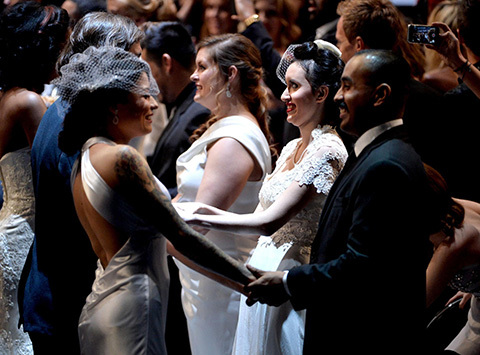
grammy_awards_2014_wedding_couplesIn an effort to avoid the sensationalist reaction that seems to be norm at current events, I refrained from blogging about the events of the 2014 Grammys. More specifically, I resisted the urge to pontificate about the mock wedding ceremony to Macklemore’s Same Love, which was designed to demonstrate that same sex marriage was no different than traditional marriage.

I concur with this tweet

I’m not sure when the Grammy’s became something more than music and a platform for a social cause, but nonetheless, there it was. Ed Stetzer of Christianity Today wrote an interesting commentary on the matter about what the Grammys really revealed was a shift in society,

Now, the Grammy Awards presentation is not the show you watch for high-brow cultural commentary or family-friendly entertainment. News reports indicate that many parents were shocked by Beyoncé (among others). I honestly have to wonder if these parents have heard of Beyoncé before now, and why were they expecting the Grammys to be family friendly. (J. Lo’s dress from 2000 is easy to recall from the dark recess of our memories.)

So, the Grammys are not representative of our culture, but in some ways they are indicative of its shifts. And, the Grammy moment is a good moment to remind ourselves of a few things. Continue reading

The Bible Study I Think We Really Need

person reading bibleI recently saw a publishers list of forthcoming books, most of which were academically oriented but at the same time, user-friendly type material. I couldn’t help but notice yet more books on “how to read the Bible”.  Now anyone who knows me, knows my passion for this area. As one who spent many years reading Scripture in a fragmented way with the tendency to impose presuppositions on to the text. This is because the teaching I was exposed to informed the method by which I was reading Scripture and interpreting accordingly.

Over the past several years, my studies have reverted to understanding Scripture more holistically, historical and cultural background, how language is being used, who the author’s were and what were they addressing, how the events of each book relate to the overall grand narrative of what God is accomplishing in redemptive history. But most importantly how Christ is at the center of it all. This has cut down on the tendency to take passages out of context and impose prescriptions where they really don’t exist in the narrative.

So I get that we need the “how to” books that break down good reading methods. A good study bible will have articles in it for this very purpose (I recommend the ESV Study Bible). Also, there’s Gordon Fee’s How to Read the Bible for All its Worth.

But I don’t think this goes quite far enough. I could be wrong, but the problem does not seem to be that Christians don’t read the Bible, though that has been on the decline. Even the ones who do are already reading with certain presuppositions. The rise in Biblical Studies have given the impression that we can read Scripture with a neutral lens but that’s a problem. I love what Derek Rishmawy says about that here. And as I wrote about here, no one comes to the text neutral. No matter how objective we think we are being, there are presuppositions that are being imposed on the text. Continue reading

Finding Beauty in a Broken World

I love this song by the late Rich Mullins. And one line in particular stands out “there’s so much beauty around us for just two eyes to see.


Now one might listen to this song and immediately be struck by some contrasts. The first is that he seems to suggest that God is really at work in America, as opposed to other places. But I think that misses what he is saying in this song. It’s not an anthem about nationalization but about God’s work through the world that he created.  And this raises an obvious observation regarding all the ugliness in the world.  Sure it is beautiful for some, but what about all the displays of our broken world – poverty, homelessness, abuse, crime, drugs, urban blight.

Because the reality is that we do live in a broken world. If we are to take the events of Genesis 3 serious, we acknowledge that something went terribly wrong that subjected all creation to sin and futility, as Paul tells us in Romans 8. We cannot ignore the depravity of humans, who cannot accept God on his terms except for the intervening work of the Holy Spirit. Man’s rejection of God through acceptance of his Son has certainly created animosity against his creation, creatures included. One only needs to take a glimpse at the news to know that’s true. Continue reading

Catching the Anointing

charismatic gatheringI fear this post might confront some popular held beliefs about the word anointing. But if there is ever a word that is overused and abused, its this word. For awhile, I’ve been wanting to address how anointing is actually used in the Bible but James White of Alpha and Omega ministries has done a superb job. He addresses the phenomenon of catching the anointing that occurs at mass gatherings, using Benny Hinn as an example and compares it to how the Bible uses anointing.

Here is the key excerpt from White;

“Does the Bible know anything of an anointing that can be ‘received’ through the yelling of the word ‘fire’ and the waving of a garment (accompanied by choreographed music, lighting, choirs, etc.)?  No, it does not.  Most of the appearances of the term (χρίω; χρῖσμα, τος) have to do, of course, with the Messiah, the anointed one.  But it does appear in reference to believers:

The One Who establishes us together with you in Christ and anointed us is God, who also sealed us and gave us the Spirit in our hearts as a pledge.  (2 Corinthians 1:21–22)

This anointing is defined as the work of God and it is clearly connected with the dwelling of the Spirit in the believers, resulting in their union with the body of Christ.  It is not some ecstatic secondary experience that comes later, it is primary, foundational, and universal.  It is not something offered at revivals, it is definitional to what makes a person a Christian in the first place.  It is not mediated by traveling evangelists, it is the direct and powerful work of God in the salvation of his elect people.  Likewise, the phraseology appears in John’s epistle: Continue reading

A Radical New Year’s Resolution

NewYearResolutions banner2014 is here. The lists have started with various resolutions with the goal of somehow making us better. Improve at this or finish that project or live up to whatever standard we failed at in 2013.

Christians will likely go further and put a spiritual dress on it to be a better Christian than they were in 2013. More bible reading, more prayer, stronger church commitment, change that habit, less sin, more love, better relationships. Be better, do more, try harder. Strive to be a good Christian. Whew!

I don’t know about you, but it sounds exhausting. One of the reasons I’ve ceased with New Year’s resolutions is because no matter how motivated or sincere I may be at the beginning of the year, inevitably I fall off the wagon. Then the cycle repeats itself at the start of each year. It can get discouraging.

Now I’m not saying we should not have goals, not improve or tend to growth areas in our lives. I’m certainly not saying that we should be negligent or slothful about our Christian walk. But what I am saying is that I think the focus is wrong when we think that the way to improve our Christianity is create a list and turn into New Year’s resolutions to be better Christians. Continue reading