A Sure Word (Pt 1)

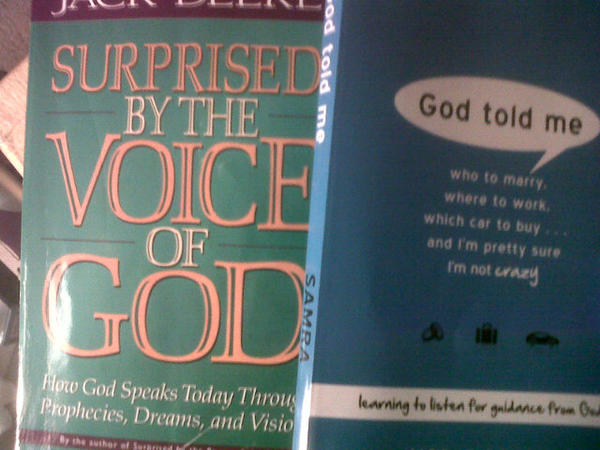
Deere and SamraIn working through my thesis, I’m interacting with some popular level books that advocate seeking the voice of God, hearing God speak regarding whatever dilemma we are facing or just to give encouragement or direction. And this seems right to so many because we ARE in relationship with the living God who continues to move by the Holy Spirit, right? Well not so fast.

I’m addressing the fact that God already spoke through Scripture and explaining why that is so. Of course, we need to define what it means for God to speak, which is his verbal revelation. Whatever propositional knowledge of himself he wanted to convey, has been conveyed progressively through the Old Testament as he spoke through word and historical acts in establishing a covenantal relationship with his people. Both word and deed get accomplished through the Son, through whom the words of the Old Testament are validated and the New Testament explains.

But I’m also reminded of the fact that we do face uncertainty, difficulty, confusion or fear. We do face times of doubt and discouragement. Being in relationship with an invisible God can cause us to ache for the tangible. We are humans after all.

So many do what these writers I’m interacting with advocate, seeking out that tangible need in he form of soft whispers or signs, words of comfort and affirmation that we long to hear.  Somehow the Bible seems deficient and words spoken by others meet the needs of the immediate, especially when there is a claim attached to it that the Lord has spoken. Who doesn’t want a word right now for what we are going through? Continue reading

The Myth of Non-Theology and Neutrality

reading-the-BibleAs I observed a few discussion threads over the past few days on Christian topics, a theme tends to emerge. Some Christians disdain any mention of theology, doctrine or hermeneutics. You’ll get one pitted against each such as theology vs true faith or doctrine vs scripture. A typical statement goes like this that one person told me – “theology and doctrine has its place but that is not the substance of our faith.” Yes, Christ is the substance of our but to think theology and doctrine is not is both naive and not true. Not true.

Every Christian has a theology, a set of doctrine and a hermeneutic. Everyone!

Theology is whatever we think about God.

Doctrine is what we believe that theology teaches.

Hermeneutics is how we interpret what theology teaches.

If you say the substance of your faith is Jesus Christ, then you have to come to some conclusions about what that means, who he is and how you arrive at your conclusions. This is the task of theology and without it, you have no reasonable basis to come to any conclusions about the Christian faith.

This also supposes that you have some way of interpreting the facts about the Christian faith. From a Protestant perspective, this presumes that one is basing their understanding on the Bible, recognizing that it is the testimony of Jesus Christ cover to cover, breathed out by God to give us his word through the pens, personalities, and literary style of 40 authors (2 Tim. 3:16-17).  The problem then is not knowing what it is and believing that we have complete neutrality when approaching the Bible or using other means to determine our faith. We all have some way of formulating what we believe and why we believe it. Continue reading

The Bible is More than Examples

person holding bibleLast night, I went to a dinner and dialogue event that was hosted by the Dialogue Institute of the Southwest. The theme was the story of Abraham and there were two speakers representing the Christian and Muslim perspective respectively. My pastor represented the Christian perspective and did an amazing job both presenting and addressing questions during the Q & A portion. The Lord was truly at work!
I heard him explain how Abraham’s story fits into the broader context of God’s story.  He built on themes of promise and faith, spring boarding off Gen. 12:1-3 and the blessing to many descendents.  As he told the story of the son of promise and the request for a sacrifice, my skin got tingly knowing that he was building up to the ultimate giving and sacrifice of the Son. And he weaved this together masterfully, demonstrating that Abraham’s story was only a foreshadow of the main character – Jesus Christ. That God’s redemptive story involved promise and fulfillment that ultimately found in the Son because we needed a rescuer. Connecting Abraham’s story to Christ, he concluded with this passage in Galatians;

Know then that it is those of faith who are the sons of Abraham. And the Scripture, foreseeing that God would justify the Gentiles by faith, preached the gospel beforehand to Abraham, saying ‘In you shall all nations be blessed.’  So then, those who are of faith are blessed along with Abraham the man of faith.  (Gal. 3:7-9)

Christ redeemed us from the curse of the law by becoming a curse for us – for it is written ‘Cursed is everyone who hanged on a tree’ – so that in Christ Jesus the blessing of Abraham might come to the Gentiles, so that we might receive the promised Spirit through faith. (Gal. 3:13-14) Continue reading

Fortune Cookie Theology

Al Mohler posted this article recently on a call for Biblical literacy. He claims that the reason for illiteracy in the church is that people just don’t read the bible.

Researchers George Gallup and Jim Castelli put the problem squarely: “Americans revere the Bible — but, by and large, they don’t read it. And because they don’t read it, they have become a nation of biblical illiterates.” Researchers tell us that it is worse than most could imagine.

Fewer than half of all adults can name the four Gospels. Many Christians cannot identify more than two or three of the disciples. According to data from one research group, 60 percent of Americans can’t name even five of the Ten Commandments. Americans may demand that the Ten Commandments be posted in the courthouse, but they seem unable to remember what exactly they are.

According to 82 percent of Americans, “God helps those who help themselves,” is a Bible verse. Those identified as born-again Christians did better — by one percent. A majority of adults think the Bible teaches that the most important purpose in life is taking care of one’s family.

One poll indicates that at least 12 percent of adults believe that Joan of Arc was Noah’s wife. Another survey of graduating high school seniors reveals that more than 50 percent thought Sodom and Gomorrah were husband and wife. A considerable number of respondents to one poll indicated that the Sermon on the Mount was preached by Billy Graham. We are in big trouble. Continue reading

What is a Cessationist?…or Why I think We Need Another Term

When you think of the word ‘cessationist’ what comes to mind? Typically, I’ve seen these characterizations;

  • Opposite of a continuationism
  • One who no longer agrees the gifts of the Spirit are in operation
  • No miracles
  • Prophets and apostles no longer exist
  • Not all gifts are in operation; some have ceased
  • God no longer speaks beyond scripture

person holding bibleIt’s a mixed bag that unfortunately brings some baggage in discussions involving continuationism vs. cessationism OR discussions regarding if God still speaks today. Given the above descriptions, what is that exactly? It’s a problem because when you say the word it means different things to different people. Even under the rubric of continuation of all gifts, some cessationists avow this happens but not in the manner.

Wayne Grudem is amongst the continuationists but one who adheres to the sufficiency of scripture as God’s word. In his Systematic Theology he says this about prophecy; Continue reading