What Her says about Him

Her_Theodore in front of computerTheordore Twombly was a sweet, soulful and complex man who lives in a virtual world. If you’ve seen the movie Her, you would recognize him as its main character played by Joaquin Phoenix.  Little seems to be real in Theodore’s world. His work involves writing heartfelt letters on behalf of others he does not know. For recreation, he cozies up to a larger than life video game. Outside of the venues, he has little interaction with others, expect for the sporadic encounters with his neighbors…and an earwig that pretty much stays implanted in his ear and serves as his lifeline to his parallel universe.

To be sure, Theodore lives in two worlds, preferring the company of electronic stimulation of his senses to the extent possible. Yet despite all the stimulation, Theodore appears to be a lonely man. Having experienced a recent divorce, he strives to find pleasure in this detached reality but never quite getting there.  That is, until he meets Samantha. She turns him on. She seems to provide him with what he lacked despite all his stimulation. She makes up for the pain of the loss of relationship and draws him to herself.  She is an OS system with a seductive voice and witty charm. If you’ve not seen the movie, you might find this strange but it seems even stranger watching it. It is both odd and captivating the way  Theodore finds relief for his frustrations, need for companionship and even sexual tension through a relationship with an OS system, whose voice streams through his constant companion of the ear wig.

Yet Theodore instinctively knows there is something better. Something is missing. Why else does he search? He knows there is a goodness to be grasped that will touch his soul – something tangible; something real. He mistakenly believes it is in this virtual reality. As the movie progresses and the relationship between he and Samantha explore depths beyond human imagination, he simultaneously finds relief and discomfort.  Samantha ends up pulling the plug on the relationship, leaving Theodore grasping to fill the void.  Through the complexities of this human-machine relationship, his friendship with his neighbor Amy intensifies, and the machine dumped Theodore and Amy end up turning to each other for solace.  Though safely now in boundaries of human relationship, it is nonetheless a glimpse that we yearn for something more. Continue reading

A Theology of Jerkiness

shouting guys_anger managementRecently, a friend put a plug in my ear about intellect vs. empathy and something I want to do some further research on after this last hump of school assignments is over. But the more I think about these two dynamics the more I’m giving a nod to the fact that Christians are to operate out of the latter. So I wanted to sketch out some preliminary thoughts.

Now, I don’t want to draw any false dichotomies. To be clear, I’m not suggesting that we should be anti-intellectual. Heavens no! Our intellect is “the power or faculty of the mind by which one knows or understands”. Intellect has nothing to do with being smart but using reasoning and logic.  We need to use our mind, critically evaluate, analyze and reason. This is a good thing when used properly.

Empathy on the other hand, allows us to put ourselves in the other person’s place and discern what’s right for a situation. Empathy doesn’t neglect intellect but doesn’t allow it to take the reigns. Where intellect cares about the information, empathy cares about people.  Empathy knows when an intellectual response is inappropriate and has the ability to keep quiet or fashion a response appropriate to the situation.  Yes truth matters. Yes the right information about the gospel and the triune God matters. Empathy will know when information has to be contextualized because of the people involved. But see if I’m operating out of intellect and not empathy, I’m only concerned about information and what is correct and logical. I will justify my actions to prove what is the right information as I see it. Right information can actually be harmful if not treated with empathy. Continue reading

Redemption and the Ultimate Reality

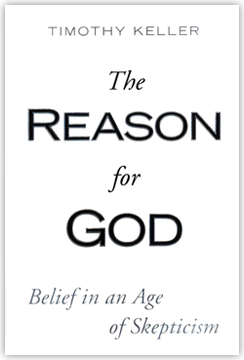
reason for God_kellerI’ve been reading through The Reason for God by Tim Keller as a requirement for my evangelism class. But I must say, I love this book and the reasonable and winsome way the Keller addresses Christianity and the counter-claims to it.  The first half of the book he tackles the common arguments against Christianity as evidenced by the chapters titles. In the chapter entitled Science Has Disproved Christianity, he deals with the rational-oriented arguments against miracles and concludes with an important note;

I don’t want to be too hard on people who struggle with the idea of God’s intervention in the natural order. Miracles are hard to believe in, and they should be. In Matthew 28 we are told that the apostles met the risen Jesus on a mountainside in Galilee. ‘When they saw him, they worshiped him; but some doubted (vs. 17). That is a remarkable admission. Here is the author of an early Christian document telling us that some of the founders of Christianity couldn’t believe the miracle of the resurrection, even when they were looking straight at him with their eyes and touching him with their hands. There is no other reason for this to be in the account unless it happened.

The passage shows us several things. It is a warning not to think that only we modern, scientific people have to struggle with the idea of the miraculous, while ancient, more primitive people did not. The apostles responded like any group of modern people – some believed their eyes and some didn’t. It is also an encouragement to patience. All the apostles ended up as great leaders in the church, but some had a lot more trouble believing than others.

The most instructive thing about this text is, however, what it says about the purpose of the biblical miracles. They lead not simply to cognitive belief, but to worship, to awe and wonder. Jesus’ miracles in particular were never magic tricks, designed only to impress and coerce. You never see him say something like: ‘See that tree over there? Watch me make it burst into flames!’ Instead, he used miraculous power to heal the sick, feed the hungry and raise the dead. Why? We modern people think of miracles as the suspension of the natural order, but Jesus meant them to be the restoration of the natural order. The Bible tells us that God did not originally make the world to have disease, hunger, and death in it. Jesus has come to redeem where it is wrong and heal the world where it is broken. His miracles are not just proofs that he has power but also wonderful foretastes of what he is going to do with that power. Jesus’ miracles are not just a challenge to our minds, but a promise to our hearts, that the world we all want is coming. Continue reading

The Gospel in the OT

OT_Tents of IsraelI spent many years of my Christian life reading the Old Testament in a disjointed and fragmented way, reading the events more as prescriptions than as a revelatory phenomonon through which God communicated himself. Over the past several years, an evolution of sorts has occurred that has caused me to consider the 66 books more holistically.

I’m working through the section of my thesis in connecting the Jesus the word incarnate to the written word of God, having built on themes of revelation and prophecy. As I mentioned here, the OT is more than just examples for us to follow but shows how everything God did testifies to Christ. He is the subject of Scripture. Scripture is sufficient because it testifies to Christ. Jesus tells us this in Luke 24:27

“And beginning with Moses and all the Prophets, he interpreted to them in all the Scriptures the things concerning himself.”

I loved the way Philip Ryken put it in his commentary

Jesus is not just here or there in this prediction or that prophecy; he is everywhere in the Old Testament. He is the ark of the covenant and the blood on the mercy seat. He is the light on the golden lampstand and the bread of life. He is the prophet who preaches like Moses, the priest who prays like Aaron, and the king after David’s heart. We follow his method of interpretation when we see Jesus in the redemption of Ruth by Boaz, the selfless act of Solomon, the kingship of Josiah, the miracles of Elijah, and all the other types and signs and figures of the Old Testament. Continue reading

What the Grammys Really Revealed

grammy_awards_2014_wedding_couplesIn an effort to avoid the sensationalist reaction that seems to be norm at current events, I refrained from blogging about the events of the 2014 Grammys. More specifically, I resisted the urge to pontificate about the mock wedding ceremony to Macklemore’s Same Love, which was designed to demonstrate that same sex marriage was no different than traditional marriage.

I concur with this tweet

I’m not sure when the Grammy’s became something more than music and a platform for a social cause, but nonetheless, there it was. Ed Stetzer of Christianity Today wrote an interesting commentary on the matter about what the Grammys really revealed was a shift in society,

Now, the Grammy Awards presentation is not the show you watch for high-brow cultural commentary or family-friendly entertainment. News reports indicate that many parents were shocked by Beyoncé (among others). I honestly have to wonder if these parents have heard of Beyoncé before now, and why were they expecting the Grammys to be family friendly. (J. Lo’s dress from 2000 is easy to recall from the dark recess of our memories.)

So, the Grammys are not representative of our culture, but in some ways they are indicative of its shifts. And, the Grammy moment is a good moment to remind ourselves of a few things. Continue reading