The Little Things: thoughts on race, compliance and subtle discrimination

Black_businessman among whitesI don’t usually write on issues of race and for good reason: it tends to garner heated debate, polarized perspectives and people talking past one another. In “post-racial” America, its tough to talk about issues of oppression and injustice because of all the progress Blacks have made in this country. After all, slavery ended 150 years ago, Jim Crow is over, the “Whites Only” signs have been removed, schools are integrated, and Blacks have risen to prominent stations in society.

Everything seems to be ok until something happens…like Ferguson and now Eric Garner. Then issues of race rise to the surface. Then something happens, I’ve noticed, something subtle yet prominent. There is still an undercurrent of inequality and trickles of suppression in drips of dispositions towards these kinds of incidences.

The premise of racism in America has been built on perception and belief that the Negro was inferior to Whites. It was ok to ship men, women and children like cattle and sell them off like property. For a country that was founded on the premise that all men were created equal, that equality came with a qualification for Blacks as the sub-dominant group. Sure there were free Blacks, but freedom was only free as long as it was granted.

As the dominant group, Whites also wrote the narrative for parameters and progress. Whatever Blacks had, they were allowed to have with the expectation of gratitude towards the giver, especially acute in places of slavery. There was also an firm expectation of compliance.

Go along to get along. Know your place. Lower your eyes. Don’t make waves. The negro dare not rebel or face the consequences. Continue reading

Read’em and Weep . . . or not

computer yellingThe other day, a good friend gave me a gentle rebuke. The reason? I had articulated an opinion about a current event that I didn’t have a wealth of knowledge in.  Sure I knew the basic facts but not enough to spit out what I thought of the matter. Though it was tough to hear, I had to acknowledge that I had engaged in a bit of hypocrisy by doing exactly what I recommend that we don’t do – arriving at premature conclusions based on superficial information.

We live in an age of information overload, an embarrassment of riches that on the surface would support an incredible wealth of knowledge. And yet, it’s just the opposite – fragmented, de-historified pieces of media sound bytes that are designed to sway us towards a certain opinion. It doesn’t matter what the topic, whether current events, history or theology. We get lured with attractive titles and questions that appeal to our particular affinities, especially when it’s fueled by an particular image. If we are not careful, that biased slant with its emotional appeals can suck us right in.

When we propagate un-informed or poorly informed opinions through social media, it only adds fuel to the fire. In fact, this is where I’ve seen the down side even to blogging, which I love so much. It gives anyone who wants to say something the opportunity to do so regardless of how much is understood about the topic. Expertise has indeed taken a hit. I’ve become increasingly more cautious in my assertions because of this, though maybe not all that successful at times.

When it comes to the media outlet today, let’s not fool ourselves that you will read objective opinions.  Sure, there are some writers who strive to portray what they would deem “objective”. But that that object always has some question it is trying to answer based on some perspective, which may not be that objective at all.

I follow a variety of different news sources from various perspectives. Some are straight news, some focused on politics and economics, some economic perspectives from a Christian worldview, conservative, liberal, moderate. And of course my beloved theology! Regardless of what I read,  I strive to remember the ideology that pervades the thoughts behind each post to gauge where the author is coming from.  And yet, I am sometimes lured in by well-sounding arguments, especially where there appears to be some kind of authentic research or historical sketch. Continue reading

What Her says about Him

Her_Theodore in front of computerTheordore Twombly was a sweet, soulful and complex man who lives in a virtual world. If you’ve seen the movie Her, you would recognize him as its main character played by Joaquin Phoenix.  Little seems to be real in Theodore’s world. His work involves writing heartfelt letters on behalf of others he does not know. For recreation, he cozies up to a larger than life video game. Outside of the venues, he has little interaction with others, expect for the sporadic encounters with his neighbors…and an earwig that pretty much stays implanted in his ear and serves as his lifeline to his parallel universe.

To be sure, Theodore lives in two worlds, preferring the company of electronic stimulation of his senses to the extent possible. Yet despite all the stimulation, Theodore appears to be a lonely man. Having experienced a recent divorce, he strives to find pleasure in this detached reality but never quite getting there.  That is, until he meets Samantha. She turns him on. She seems to provide him with what he lacked despite all his stimulation. She makes up for the pain of the loss of relationship and draws him to herself.  She is an OS system with a seductive voice and witty charm. If you’ve not seen the movie, you might find this strange but it seems even stranger watching it. It is both odd and captivating the way  Theodore finds relief for his frustrations, need for companionship and even sexual tension through a relationship with an OS system, whose voice streams through his constant companion of the ear wig.

Yet Theodore instinctively knows there is something better. Something is missing. Why else does he search? He knows there is a goodness to be grasped that will touch his soul – something tangible; something real. He mistakenly believes it is in this virtual reality. As the movie progresses and the relationship between he and Samantha explore depths beyond human imagination, he simultaneously finds relief and discomfort.  Samantha ends up pulling the plug on the relationship, leaving Theodore grasping to fill the void.  Through the complexities of this human-machine relationship, his friendship with his neighbor Amy intensifies, and the machine dumped Theodore and Amy end up turning to each other for solace.  Though safely now in boundaries of human relationship, it is nonetheless a glimpse that we yearn for something more. Continue reading

How to Help the Poor?: The Muddy Mess of a Moderate Christian

homeless-poor-american-familyI try to avoid discussions about politics with other Christians, especially when it involves economics and poverty. The reason being is that we are very quick to assign the right vs. left label.  As soon as I give support for free markets, limited government and reasons not to raise the minimum wage, I get lumped in with the conservative/ right/Tea Party camp with the caricature of not caring for the poor. But let me talk about issues related to poverty and how some form of government support is needed, I get lumped in with the left and disregarding sound economic philosophy. We love putting people in boxes And once you’re assigned to a particular camp, it then becomes ineffective to have discussions around policy issues.

It’s messy and that’s where moderates like me find ourselves. So when I say a muddy mess,  I don’t necessarily mean in a pejorative sense. This is where I get frustrated with evangelicals who would rather assign affiliations than talk about the issues. If we’re going to have honest discussions about solutions to poverty, we can’t let them get lost in a right vs. left debate.

I’ve been a registered independent for ages. I am a capitalist and believe in the free market system. I agree with this superb article by Peter Cove, who speaks about benefits of work, any work, to lift people out of poverty. We do need to take serious the culture of dependency that’s not only created generational poverty, but the overall failure to reduce federal expenditures. So I’ve wanted to register Republican for some time now but I just can’t bring myself to full alignment. Poverty is a complex animal involving disparities in resources and skills. But these complexities tend to get overlooked regarding the solutions needed to become independent of any type of government assistance.  There’s also the working poor who fail to earn a sufficient income. Its not as simple as ‘oh they just need to get a better job’. I also find it fascinating when those who uphold total depravity are less forgiving in how that has worked itself out regarding personal responsibility. Continue reading

What the Grammys Really Revealed

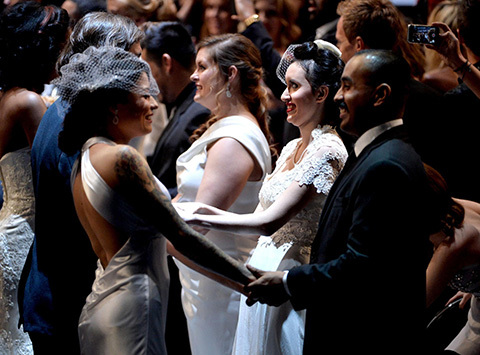
grammy_awards_2014_wedding_couplesIn an effort to avoid the sensationalist reaction that seems to be norm at current events, I refrained from blogging about the events of the 2014 Grammys. More specifically, I resisted the urge to pontificate about the mock wedding ceremony to Macklemore’s Same Love, which was designed to demonstrate that same sex marriage was no different than traditional marriage.

I concur with this tweet

I’m not sure when the Grammy’s became something more than music and a platform for a social cause, but nonetheless, there it was. Ed Stetzer of Christianity Today wrote an interesting commentary on the matter about what the Grammys really revealed was a shift in society,

Now, the Grammy Awards presentation is not the show you watch for high-brow cultural commentary or family-friendly entertainment. News reports indicate that many parents were shocked by Beyoncé (among others). I honestly have to wonder if these parents have heard of Beyoncé before now, and why were they expecting the Grammys to be family friendly. (J. Lo’s dress from 2000 is easy to recall from the dark recess of our memories.)

So, the Grammys are not representative of our culture, but in some ways they are indicative of its shifts. And, the Grammy moment is a good moment to remind ourselves of a few things. Continue reading