The Bible is More than Examples

person holding bibleLast night, I went to a dinner and dialogue event that was hosted by the Dialogue Institute of the Southwest. The theme was the story of Abraham and there were two speakers representing the Christian and Muslim perspective respectively. My pastor represented the Christian perspective and did an amazing job both presenting and addressing questions during the Q & A portion. The Lord was truly at work!

I heard him explain how Abraham’s story fits into the broader context of God’s story.  He built on themes of promise and faith, spring boarding off Gen. 12:1-3 and the blessing to many descendents.  As he told the story of the son of promise and the request for a sacrifice, my skin got tingly knowing that he was building up to the ultimate giving and sacrifice of the Son. And he weaved this together masterfully, demonstrating that Abraham’s story was only a foreshadow of the main character – Jesus Christ. That God’s redemptive story involved promise and fulfillment that ultimately found in the Son because we needed a rescuer. Connecting Abraham’s story to Christ, he concluded with this passage in Galatians;

Know then that it is those of faith who are the sons of Abraham. And the Scripture, foreseeing that God would justify the Gentiles by faith, preached the gospel beforehand to Abraham, saying ‘In you shall all nations be blessed.’  So then, those who are of faith are blessed along with Abraham the man of faith.  (Gal. 3:7-9)

Christ redeemed us from the curse of the law by becoming a curse for us – for it is written ‘Cursed is everyone who hanged on a tree’ – so that in Christ Jesus the blessing of Abraham might come to the Gentiles, so that we might receive the promised Spirit through faith. (Gal. 3:13-14) Continue reading

Seed of the Apostles

grain in bagThe past several Sunday sermons have been going through the book of Acts. Last Sunday was Acts 4:32-37. As the sermon so convinctingly emphasized the idea of dedication of our gifts and resources to the body of Christ, I couldn’t help but note the stark contrast to how this passage would be written according to philosophy of seed and harvest that is so prevalent today. I imagine it would go something like this;

Now the full number of those who believed were of one heart and soul and every one said that the things that belonged to them were a result of the seed they had planted. So they shared this in common. And with great power the apostles gave their testimony to the blessings of the Lord Jesus and the great favor that was granted them because of the seed they sowed. There was not a needy person among them because they all had planted a seed by laying it at the apostles feet so the apostles could proclaim the favor that fell upon them and proclaim the anointing of those who fell at their feet.  Thus Joseph, who was also called by the apostles Barnabas (which means son of encouragement), a Levite, a native of Cyprus, sold a field that belonged to him and took the money as his seed and laid it at the apostles’ feet so he could reap a harvest.

Um, no…and note the difference of what it actually says Continue reading

Some Dissing Required

My friend Miguel asked this question on Facebook today, “Can Christians respect beliefs that are diametrically opposed to their own”. Well, I wasn’t certain if he meant diametrically opposed to Christian beliefs or diametrically opposed to doctrinal/tradition differences within Christianity.

Nonetheless, if it was in reference to beliefs within Christianity, I could help but reflect on a Facebook discussion that occurred earlier that morning. The discussion related to a post I saw associating baptism and communion with magical rites, which basically spit on the idea sacraments.

I agree wholeheartedly with my friend Laurie’s comment in that discussion

I am growing weary of this movement of people whose goal seems to be to dismantle Christianity and the body of Christ and recreate in their own image and to suit their own desires….and all supposedly in the name of Christ. It is one thing to try to address falsehood and error, but this is something altogether different, I think. It feels like mockery.

Yeah, if feels like mockery to me, too. And it typically is because something new has been discovered about Christianity that no one else has figured out until now.

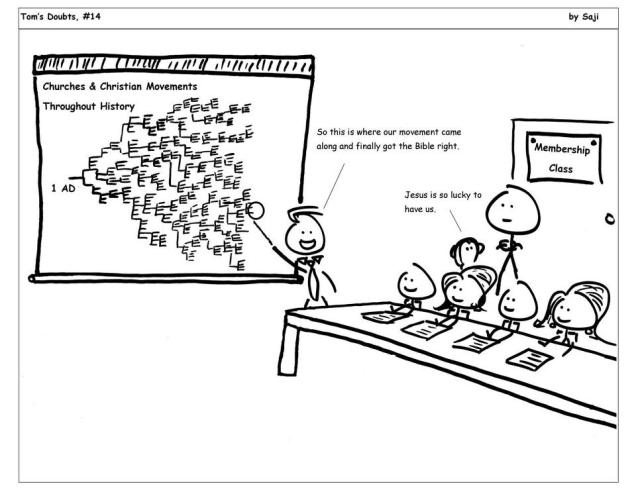
church history chart cartoon

Now new doesn’t automatically mean bad or untrue. But when 2,000 years of Christian tradition is ignored for novel concepts with the accompanying attitude of having it all figured out, I can’t help but not see that as disrespecting the church that Christ said he would build. Now clearly there has been some doctrinal splintering. But even in the disagreements, we should be able to acknowledge some validity in historical development and elements of timeless tradition that are rooted in Jesus’ own commands (including his apostles’ teaching). This transcends doctrinal/denominational perspectives and is not just related to sacraments but any component related to Christ’s church.

So back to Miguel’s question, I hate to say this but when Christians dismiss and disrespect 2,000 of church history, some dissing may be required.

Healing and the Resurrection

empty tombI don’t really have time to blog these days so forgive the brevity and superficial nature of what could be a more indepth conversation. But I came across what I consider to be an important connection in the relationship between divine healing as portrayed in the Gospels and Acts.

A debate that often gets tossed around today is the gift of healing or if healing is part of the atonement. It’s really hard to argue with the Gospels and the book of Acts that healing was very much a part of Jesus’ earthly ministry and that of the apostles.

There might be a tendency to read Acts as a prescription for life today. But keeping in mind that this is about the ministry of Jesus, which continues through the witness of his disciples. It’s why Acts 1:8 sets the precedent for the rest of the book and the purpose of the church – to testify to the Son. It’s why it kind of bothers me when we’ll focus the attention of Acts 2 on the occurrence of the baptism of the Spirit instead of the reason, summarized in vv. 14-26. Peter gets to the point of all – “Let all the house of Israel therefore know for certain that God has made him both Lord and Christ, this Jesus whom you crucified.” (vs 36) Continue reading

Church and the ‘Other’ Single

woman experiencing shameI frequently come across articles related to singles written from a Christian perspective for the purpose of giving advice to young single ladies about a host of issues related to singleness. Topics range from waiting for the right person, to being single and satisfied, avoiding sexual immorality, characteristics of a godly marriage, and so on. The thrusts of these articles point to one thing – make the right choices so you don’t end up being like ‘those singles’. You know, the ones that didn’t wait, had sex outside of marriage, maybe even had babies out of wedlock.  Do the right thing so you can have the right kind of life.

But what happens to those other singles that didn’t do the right thing? What if they are in the church as single parents (notice this same standard does not apply to single fathers)? What if they made they’re mistakes then came to Christ or even made mistakes while in Christ? Newsflash – it happens.

Not only that but there are other kinds of singles in the church aside from young, never been married, virgin single woman who wants to be married. There are older men or women who have longed for marriage but it just hasn’t happened. There are those who are quite content to be single. There are those who have been divorced (either before they became a Christian or after). There are widows (like myself). There are those whose spouse abandoned them or even those who had to escape from domestic violent situations. Some may have done all the right things but ended up with bad results. But all are single! Continue reading