Redemption and the Ultimate Reality

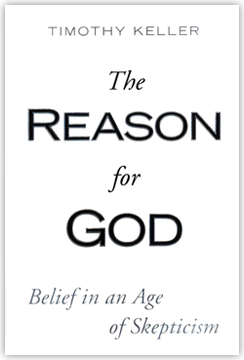
reason for God_kellerI’ve been reading through The Reason for God by Tim Keller as a requirement for my evangelism class. But I must say, I love this book and the reasonable and winsome way the Keller addresses Christianity and the counter-claims to it.  The first half of the book he tackles the common arguments against Christianity as evidenced by the chapters titles. In the chapter entitled Science Has Disproved Christianity, he deals with the rational-oriented arguments against miracles and concludes with an important note;

I don’t want to be too hard on people who struggle with the idea of God’s intervention in the natural order. Miracles are hard to believe in, and they should be. In Matthew 28 we are told that the apostles met the risen Jesus on a mountainside in Galilee. ‘When they saw him, they worshiped him; but some doubted (vs. 17). That is a remarkable admission. Here is the author of an early Christian document telling us that some of the founders of Christianity couldn’t believe the miracle of the resurrection, even when they were looking straight at him with their eyes and touching him with their hands. There is no other reason for this to be in the account unless it happened.

The passage shows us several things. It is a warning not to think that only we modern, scientific people have to struggle with the idea of the miraculous, while ancient, more primitive people did not. The apostles responded like any group of modern people – some believed their eyes and some didn’t. It is also an encouragement to patience. All the apostles ended up as great leaders in the church, but some had a lot more trouble believing than others.

The most instructive thing about this text is, however, what it says about the purpose of the biblical miracles. They lead not simply to cognitive belief, but to worship, to awe and wonder. Jesus’ miracles in particular were never magic tricks, designed only to impress and coerce. You never see him say something like: ‘See that tree over there? Watch me make it burst into flames!’ Instead, he used miraculous power to heal the sick, feed the hungry and raise the dead. Why? We modern people think of miracles as the suspension of the natural order, but Jesus meant them to be the restoration of the natural order. The Bible tells us that God did not originally make the world to have disease, hunger, and death in it. Jesus has come to redeem where it is wrong and heal the world where it is broken. His miracles are not just proofs that he has power but also wonderful foretastes of what he is going to do with that power. Jesus’ miracles are not just a challenge to our minds, but a promise to our hearts, that the world we all want is coming. Continue reading


Big Sheep Need Food…and Know Food

Whenever I run across statements from pastors that I think run contrary to the witness of Scripture, it just makes me cringe. I do so because of their responsibility to their congregation and the orienting effects of what is being promoted.  And so it was with a statement I came across the other day;

Hebrew 5:12 speaks to those who should have matured by now but are still sitting in the pew waiting to be spoon-fed. When someone says I’m leaving my church because I not being fed it may speak volumes about their lack of maturity. Only babies need to be fed, mature believers know how to feed themselves and others.

Now I don’t want to pick on one person.  But I want to leverage this comment and express a concern that is relevant on a broader scale. Because I’ve heard this statement before, that mature believers shouldn’t expect sermons to feed them. I get that pastors are challenged with people who don’t want to read their Bibles and grow. I get it and empathize. But the idea that we should not expect to be fed is so grievously unfaithful to the witness of Scripture, the task of discipleship and the purpose of preaching,

First, to say we feed ourselves runs contrary to Ephesians 4:11-16

And he gave the apostles, the prophets, the evangelists, the shepherds and teachers, to equip the saints for the work of ministry, for building up the body of Christ, until we all attain to the unity of the faith and of the knowledge of the Son of God, to mature manhood,to the measure of the stature of the fullness of Christ, so that we may no longer be children, tossed to and fro by the waves and carried about by every wind of doctrine, by human cunning, by craftiness in deceitful schemes. Rather, speaking the truth in love, we are togrow up in every way into him who is the head, into Christ, from whom the whole body, joined and held together by every joint with which it is equipped, when each part is working properly, makes the body grow so that it builds itself up in love.

sheep eating from troughWe always need the food of the gospel and Christ-centered preaching. Always! I can’t imagine that when Jesus told Peter to feed his sheep that he stipulated a caveat “until they can feed themselves”. The idea that feed ourselves runs contrary to what it means to be in the body of Christ. Maturity doesn’t happen because we feed ourselves but because we grow together in the Lord and learn how to apply godly wisdom. No matter how much even a pastor is accomplishing for the Lord, feeding of God’s truths from others is always needed. That is how we grow together in the Lord. Continue reading

On a Bright Note…When the Church Steps Up

FrustratedBlackWoman1Shortly after publishing my last post What’s a Single Mom to Do?, I thought about editing it to downplay the emotions that so clearly came through. But I decided not to because I intentionally wrote the piece from a place of raw emotion and did not want to wordsmith or otherwise water it down with a clinical application of the tensions single parents feel, and in many cases, are made to feel, in the church.  Nonetheless, I probably came off a bit harsh on the church, which is a bit unfair. There are some congregations that do demonstrate care for the realities of single parents and avoid the careless cliche-ish ways that singles, and particularly, single parents are sometimes treated.

I came across this post by Ed Cyzewski, The Church was Super Lucky to Have Me as an On-line Consultant.   I confess that was somewhat convicted having just posted a criticism of how the church handles single parent, fatherless households. Ed rightly notes that there is a substantial amount of on-line energy devoted to rebuking the church for her woes, as if she is beholden to our virtual criticism. Instead he exhorts,

I’m just wondering if we could spent a bit more time writing about what’s working, what’s good, what’s out of the ordinary and unexpectedly good and authentic.

These aren’t always the most controversial or clickable topics. Frankly, they’re often hard to find, and unbearably ordinary without the flash and flare of big personalities. Perhaps that’s why it’s hard to write about all of the things that make church wonderful. It looks like a friend who offers to bail you out of a hard time, families who bring over meals when you’re struggling, single moms who support your wife through the tumult of a newborn, pastors who share openly about the burdens on their minds, elders who listen to the congregation, and leaders who are wholly invested in making church the best experience possible for the children who show up.

There are stories of hope out there, and I’ll be honest, I need them. I need to know that some good things are happening. It’s not all celebrity preachers building mansions out there.

On that vein, I thought it would be good and encouraging to talk about some positive experiences that I’ve had, where people have reached out and cared about our situation. Continue reading

What’s A Single Mom to Do?: The Church, Singles and the Fatherless

I confess upfront that this is going to be a somewhat personal post because this is topic near and dear to my heart and one in which I have experienced great heartache. But hopefully leveraging my own angst might generate some food for thought, especially among church leaders but definitely among all the people of God.

I sometimes think we have a bi-polar disorder in the church. Now I’m not making light of those who suffer from this psychiatric condition. Why do I say that? The other day, a friend sent me a sermon on 1 Corinthians 7 that was given to singles at her church. Now granted, it was part of a series so maybe some of what concerned me was covered in another sermon. But the heart of it was pretty standard stuff I’ve heard before. Paul says singleness is better because you can devote yourself to the Lord. Don’t be over-desirous of marriage because that is idolatry (note the introduction of the dichotomies we like to create so much). If you really hate singleness and really want marriage, you probably have a problem. Bottom line, be content where you are.

single mom with kidsBut in the same breath, we sound the alarm regarding the fatherless. We decry single-mother households and their detrimental impact on boys growing up without dad. Of course, the assumption is that it is that way because the moms have no use for men. Never mind that contributing factors in these situations also includes 1) the guy totally abdicate his responsibilities; 2) the guy mistreats the woman that breaches the marriage covenant; or 3) the guy dies. Yes, I hate to break it to the statistics mongers but devaluing a dad in the home is not the only reason these situations happen. We live in a very broken world, which also produces bad kids with dads in the house. Yes, lets talk about that in the same breath as how bad off fatherless boys are. Now I’m not undermining the importance of fathers, not in the least. Only that we need to be cognizant of rash generalities and the fact that many single-mother homes would rather not want it that way.

So on one hand, we tell the single mother with the fatherless boy to be content and don’t really yearn for marriage. But on the other hand, we give her every reason to believe that her household is dire straights without a dad. What is a single mother to do? Continue reading

De-Humanizing Christianity

robots-almost-human-bionic-man-670Normally, when I put together a post, I have a clear idea of what I’m addressing and attempt to articulate a cogent thesis. I’m not so sure I’ll do that with this topic but wanted to put pen to paper about some rather unsettling thoughts that have been gurgling around in my head lately.

When you de- something its essentially removal of that element. So when I say de-humanizing, it means the removal of the human element similar to de-icing getting rid of ice from a surface. Of course, I’m not saying removing humans from Christianity because that would not make any sense. But its something along the same lines, removing the elements that make us human but more importantly, how our humanity contributes to our Christianity and co-mingles with it.

Throughout its history, Christianity has had this penchant of reaction to phenomenon that threatens it (or at least perceived that way). When it goes one way, away from orthodox belief or practice, it isn’t long before the pendulum swings the other way to preserve, fight for and uphold correct Christian beliefs.

This has been especially true in reaction to anything deemed liberal. For conservative Christians who affirm the historic doctrines of Christianity and particularly, the authority, infallibility of Scripture as the inerrant word of God, the muddying or even dismissal of doctrine in favor of what is deemed a man-centered theology naturally brings out opposition. We want God to be honored on his terms, not ours. Continue reading