Prophecy today vs. New Testament prophecy – are they the same?

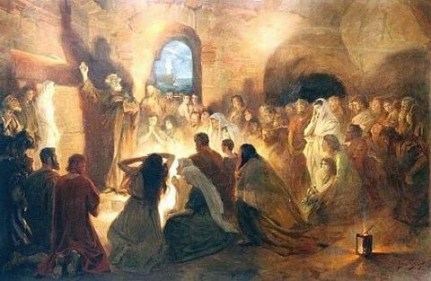
early church-peter preachingI just finished up teaching a class on a topic I’ve had my teeth in for a good while – God speaking. In fact, I wrote my master’s thesis on it as I described in this post here.

Naturally, a component of how God speaks today depends on how you consider New Testament prophecy. Just on the surface, when reading though the New Testament, especially Acts and 1 Corinthians, it does seem reasonable to conclude that we should expect that people would deliver prophecy just like they did in the Bible. In fact, I have spent much of my Christian life in churches where delivering prophecies was quite normal. Prophecies would range from exhortation to rebuking to foretelling what was in store for the church. It was also no uncommon for people to give private prophecies to individuals that typically included some type of foretelling, “look out for _____” or “in this season God is going to _______.” If you were to ask someone how did they know this was from God, a typical response would be “I just felt in my spirit.” In other words, there was some type of strong feeling that whatever words were being formed in one’s mind was God wanted to communicate.

However, the more I examine the New Testament, and specifically 1 Corinthians 14, the more I question this methodology of evaluating prophecies. I use this particular chapter as an example because I think it provides the clearest picture what transpired in the early church regarding the practice of prophecy to the body of Christ. In this regard, I think it can present the biggest challenge to a cessationist position that concludes that prophecy no longer exists, or at least the office of prophet no longer exists.

Without going too in depth and explaining in a cursory way, what I argue in my thesis and further developed in preparation for this class is that New Testament prophecies were proclaiming what the testimony of the apostles meant for the church. Keep in mind that during the New Testament accounts, the church had the Old Testament Scriptures, the testimony of the apostles and the word of the prophets. There was not a completed Bible. However, a holistic understanding of God’s self-revelation to humanity will see that the foundation of Old Testament provided the basis for what would be fulfilled in Christ, who completely and ultimately expresses the mind, will, character and plan of God. All New Testament activity portrayed in the epistles must rightly find their place in what God has done through the Son.

In light of this connection between Old and New Testaments, John Child, professor of New Testament studies at George Whitfield College in South Africa, states this in a fabulous essay entitled Towards an Evaluation of Charismatic Prophesies;

Since prophets claim their prophecies are from God and should be heeded, we should expect them to be tested under the new covenant We should expect the theological test to reflect theological development from old to new covenant; not just a fidelity to Yahwey but to Jesus Christ, not just to content in keeping with the Torah or Old Testament but in keeping with the progressive revelation or full revelation in the New Testament.
Continue reading

Christian, you cannot read the Bible any old way you want – Part I

I am often confronted with the strange ways the Bible is interpreted. I don’t mean the deviations in various interpretations, such as baptism, spiritual gifts or eschatology, but interpretations that subject the meaning of the Bible to standards that are disconnected from it’s nature and purpose.

I came across this hilarious video from the new Family Feud game that is hosted by Steve Harvey. Take a listen;

Funny and yet sobering, reminding me of ways in which some treat the Bible as if we can make it be whatever response we want AND get excited about it! I find so often that this brother’s “Texas” can be our approach to the Bible. By that I mean, employing methods that have nothing to do with the Christ-centered theme of Scripture. I’m talking about reading definitions into the text or extracting meaning out of the text that is not even related to what the author is trying to communicate or even connected to God’s redemptive narrative of what he is accomplishing through the Son.

Over at The Gospel Coalition, David Schrock has provided both a fine example of how we can disconnect passages from their intended meaning. In Jabez and the Soft Prosperity Gospel, Schrock indicates that the primary reason for interpretations that result in a sub-Christian or anti-Christian paradigm results from making personal applications of Scripture and not considering how passages relate to the overall theme of Scripture. Continue reading

So you think you believe the gospel, huh?

Despite the increasing opposition to Christianity, let’s face it, in western civilization it’s pretty easy to proclaim Christianity as one’s established religion.

What is the gospel? It is God’s rescuing his creation from the ownership of sin that happened at the fall through his work in the Son. It is recognizing the fact that something went terribly wrong in Genesis 3 that disconnected all mankind from eternal communion with God and subjected creation to futility (Romans 8:19-21). The gospel is the good news of redemption, forgiveness of sins, reconciliation with the Father and hope of enjoying him forever (See Eph 1:3-14). The gospel is sourced in God’s work through the Son, whose sacrificial atonement on the cross nailed the debt of sin for those who believe and whose resurrection forever expunged the condemnation associated with that required payment. (The first 8 chapters of Romans pretty much sums this up.)

I think its safe to say that if you’re a Christian, you might automatically nod or even get a little smug since you probably would rattle off different iterations of this description. You wouldn’t hesitate to say, yes I believe the gospel because I believe that Jesus died for my sins.

arrogance1-2But do you really believe the gospel? See it’s one thing to know facts about God’s work through Christ in rescuing what was lost. But it’s quite another to live as if that is true. It’s one thing to say that it took the work of God by the Holy Spirit to bring us into union with Christ completely on his work, but quite another to put assurance in that work and not on ourselves. It’s one thing to verbalize that you were dead in your trespasses and sins, cut off, unable to even respond to God without his intervention, it’s something else all together when we act like we can qualify the gospel with our contributions.

Here’s a little test…

1) Do you feel like you’re a good Christian because you haven’t committed any egregious sins?

If you’re proud of yourself that you’re not like those who have fallen into error, chances are you believe that you had something to do with your righteousness. That’s not believing the gospel but our own works

“For by grace you have been saved through faith. And this is not your own doing; it is the gift of God, not a result of works so that no one my boast.” (Eph. 2:8-9) Continue reading

Yes, God does do as He pleases: confronting the idol of excitement

crowd_cheeringOver at The Gospel Coalition, Erik Raymond wrote how the cessationist position concerning gifts often receives the rebuttal, aptly titled for his piece, Don’t Put God in a Box. By cessationism, he means that the operation of certain gifts as normative practice have ceased. Since he uses the word normative, I can’t tell whether he means it can’t happen at all or rather there is no need for God to move this way in general today. I think this is an important clarification since the cessationist position often gets interpreted as not believing in miracles. Though there are some cessationist who take the position, I think it safe to say they are in a small minority. The rest of us would contend that God can work as he pleases  but does he really need to on a regular basis?

Nevertheless, this gets to the thrust what interested me about Raymond’s piece that I want to connect to a couple of other areas in which some say God must move. He rightly asserts that the God in a box argument is actually limited because it restricts movement of God to extraordinary events instead of seeing the whole of what God does in his divine Providence.

Now we see the issue clearly. It is not so much the gifts as the activity of God. We also see something of the reflex of 21st Century, particularly Western Evangelicalism. The thought is that the evidence of God working in the world is the miraculous. God shows up and we all know it. We know God is working when tragedy is averted, disease is healed, life is spared, and the occurrence of personal experiences that cannot be explained.

But, what if God’s work is far more than this? What if his activity in the world is not limited to our perception of the miraculous? What if God’s activity in the world is less like Superman—rushing in to ‘save the day’ and then rushing out before he is spotted—and more like Atlas—holding the weight of the world on his shoulders? What if God is not actor in the story of our life but that we are in his story? What if God is the writer, director, producer, main character, and set designer?

The doctrine of Providence helps us here. Providence is God’s infinite power that upholds and governs all things that come to pass. As the Heidelberg Catechism says,

“God’s providence is his almighty and ever present power, whereby as with his hand, he still upholds heaven and earth and all creatures and so governs them so that: leaf and blade, rain and drought, fruitful and barren years, food and drink, health and sickness, riches and poverty, indeed all things, come to us not by change but by his fatherly hand.”

The main things you need to know about this is that God is not disconnected from what is happening in the world today. God is upholding, governing, and ordering all things as with his very hand.

Continue reading

End times and ever-fearful Christianity

scared-crowdI have often thought that eschatology, the doctrine of the end times, gets treated as a tag-on to Christian theology. In other words, it is possible to treat how we view the end as something additional to what we would consider the primary basis of Christianity.

From first to last, and not merely in the epilogue, Christianity is eschatology, is hope, forward looking and forward moving, and therefore also revolutionizing and transforming the present. The eschatological is not one element of Christianity, but it is the medium of the Christian faith as such, the key in which everything in it is set . . . Hence eschatology cannot really be only a part of Christian doctrine. Rather, the eschatological outlook is characteristic of all Christian proclamation, and of every Christian existence and of the whole Church.[1]

Yes, the truth is that our view of eschatology shapes the lens through which we view our Christian life in the here and now. And there is no greater display of this than when tragic or culture shifting events happen in our society. Most notably, I can’t help but note the hysteria that has happened among Christians regarding the Supreme Court ruling declaring same-sex marriage legal in all 50 states. This has sent many Christians into a fearful tizzy with common declarations that this must be the end times.

I think one of the reasons for this presumption is a faulty understanding of end times interchangeably known as the last days. Many Christians view the end times as a series of cataclysmic events that happen to usher in a 7 year period that is commonly known as Great Tribulation (but not before the rapture of the church) prior to Christ’s final judgement (dispensational premillennialism). In this line of thinking, it makes sense that every disruptive event might be a sign that sets off this chain of events leading to the final judgment. It’s not surprising then, that this scenario elicits fear. Continue reading