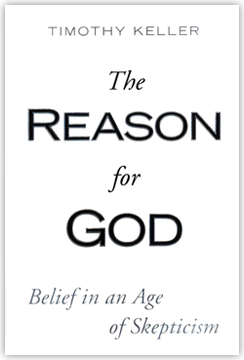
 I’ve been reading through The Reason for God by Tim Keller as a requirement for my evangelism class. But I must say, I love this book and the reasonable and winsome way the Keller addresses Christianity and the counter-claims to it. The first half of the book he tackles the common arguments against Christianity as evidenced by the chapters titles. In the chapter entitled Science Has Disproved Christianity, he deals with the rational-oriented arguments against miracles and concludes with an important note;
I don’t want to be too hard on people who struggle with the idea of God’s intervention in the natural order. Miracles are hard to believe in, and they should be. In Matthew 28 we are told that the apostles met the risen Jesus on a mountainside in Galilee. ‘When they saw him, they worshiped him; but some doubted (vs. 17). That is a remarkable admission. Here is the author of an early Christian document telling us that some of the founders of Christianity couldn’t believe the miracle of the resurrection, even when they were looking straight at him with their eyes and touching him with their hands. There is no other reason for this to be in the account unless it happened.
The passage shows us several things. It is a warning not to think that only we modern, scientific people have to struggle with the idea of the miraculous, while ancient, more primitive people did not. The apostles responded like any group of modern people – some believed their eyes and some didn’t. It is also an encouragement to patience. All the apostles ended up as great leaders in the church, but some had a lot more trouble believing than others.
The most instructive thing about this text is, however, what it says about the purpose of the biblical miracles. They lead not simply to cognitive belief, but to worship, to awe and wonder. Jesus’ miracles in particular were never magic tricks, designed only to impress and coerce. You never see him say something like: ‘See that tree over there? Watch me make it burst into flames!’ Instead, he used miraculous power to heal the sick, feed the hungry and raise the dead. Why? We modern people think of miracles as the suspension of the natural order, but Jesus meant them to be the restoration of the natural order. The Bible tells us that God did not originally make the world to have disease, hunger, and death in it. Jesus has come to redeem where it is wrong and heal the world where it is broken. His miracles are not just proofs that he has power but also wonderful foretastes of what he is going to do with that power. Jesus’ miracles are not just a challenge to our minds, but a promise to our hearts, that the world we all want is coming. Continue reading



 My friend Damian and I had a recent email exchange regarding preaching tendencies related to the contemporary evangelical culture. This comes with a philosophy that we need to be so relatable that it ends up obscuring God’s overall redemptive program. He talked about this one class in his seminary program in which discussions of Song of Solomon which resulted in placing a good dose of emphasis on human sexuality. With his permission, I’m posting his full response:
 TheoThoughts