Why I Think L.A. Preachers Need a Reality Show

l.a. preachersI know that sounds strange coming from me, but let me explain. I came across this article from Thabiti Anyabwile over at The Front Porch, a new site to foster discussion around biblical faithfulness in the black church. Thabiti gives a break down of the scenes from the trailer. He then concluded with a section asking what are we to make of all this?

In a comment to The Christian Post, Noel Jones responds to criticism by saying the show is “no evangelical tool”. He explains:

“My original intention was (for) it to be a tool to help bring the minds of Christian people to the place where they give some balance to who their pastors are and how they deal with their pastors,” said Jones. ”The only reason I signed up was to help to reduce the iconoclastic proclivities that church members have about their pastors to the point where if they break any of the rules that the church members are breaking, they completely throw them away.”

Thabiti responds by saying this;

To be clear, an ‘iconoclast’ is someone who destroys icons. A ‘proclivity’ is a strong tendency, a bent, a habit, usually toward something negative. What Jones intended to say is he wants to reduce the tendency to idolizing—making idols of—pastors and church leaders. That’s a good aim. There’s not much “iconoclastic proclivity” on display in these churches—just the opposite. Continue reading
Some Dissing Required

My friend Miguel asked this question on Facebook today, “Can Christians respect beliefs that are diametrically opposed to their own”. Well, I wasn’t certain if he meant diametrically opposed to Christian beliefs or diametrically opposed to doctrinal/tradition differences within Christianity.

Nonetheless, if it was in reference to beliefs within Christianity, I could help but reflect on a Facebook discussion that occurred earlier that morning. The discussion related to a post I saw associating baptism and communion with magical rites, which basically spit on the idea sacraments.

I agree wholeheartedly with my friend Laurie’s comment in that discussion

I am growing weary of this movement of people whose goal seems to be to dismantle Christianity and the body of Christ and recreate in their own image and to suit their own desires….and all supposedly in the name of Christ. It is one thing to try to address falsehood and error, but this is something altogether different, I think. It feels like mockery.

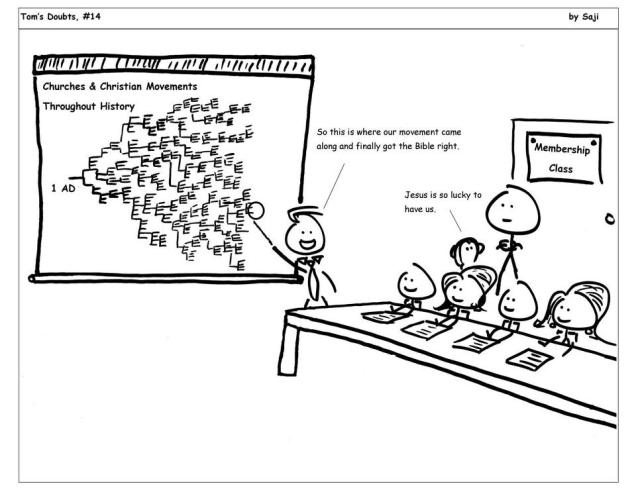
Yeah, if feels like mockery to me, too. And it typically is because something new has been discovered about Christianity that no one else has figured out until now.

church history chart cartoon

Now new doesn’t automatically mean bad or untrue. But when 2,000 years of Christian tradition is ignored for novel concepts with the accompanying attitude of having it all figured out, I can’t help but not see that as disrespecting the church that Christ said he would build. Now clearly there has been some doctrinal splintering. But even in the disagreements, we should be able to acknowledge some validity in historical development and elements of timeless tradition that are rooted in Jesus’ own commands (including his apostles’ teaching). This transcends doctrinal/denominational perspectives and is not just related to sacraments but any component related to Christ’s church.

So back to Miguel’s question, I hate to say this but when Christians dismiss and disrespect 2,000 of church history, some dissing may be required.

Church of the Lonely Place

megachurch_2I came across this article You Need a Pastor and a Church, Not Just a Podcast and Speakers. The author draws a contrast between those who participate in the life of a local assembly and those who suppose that streaming in a message is good enough for spiritual food. He rightly states that Christian growth requires more than a good message in individualistic practice, but a gathering together with God’s people;

Church is more than a sermon. It is singing with the saints, speaking and hearing words of encouragement, praying together, serving one another, opening your life and home, giving of your time, treasures and talents, taking communion and celebrating baptism. The preaching of the Word is a fundamental aspect of the local church but not the sole activity in which we engage.

Such reductionism is dangerous to our souls because it removes us from the very mediums through which God sanctifies His saints.

Consider a few of the more obvious costs if your primary church experience is vicarious and virtual:

  1. Deep community is sacrificed, and thus there are limited opportunities to be sanctified through mutual encouragement and exhortation.
  2. The sacraments are sacrificed, and thus there are limited opportunities to be sanctified through regular participation in communion and baptism.
  3. Church discipline is sacrificed, and thus there are limited opportunities to be sanctified through loving correction.
  4. Service and mission are sacrificed, and thus there are limited opportunities to be sanctified through selflessly giving yourself for the sake of others.

Those who seek sanctification primarily through radio, television or podcast ironically reject the very means provided by God to cultivate holiness. They, instead, foster individualism and isolationism, which begets self-centered, new age spirituality, not deep authentic Christianity. Continue reading

When Tradition Fails to Reach, What to Eliminate?

church stage_emptyEd Stetzer recently published this article Three Things Churches Love that Kill Outreach. No surprise, he takes a swing at tradition citing #3 – Too many churches love their traditions more than their children.

Here’s what he wrote;

How can you tell? They persist in using methods that are not relevant to their own children and grandchildren. Far too often, church leaders, in an effort to protect the traditions of their congregations, draw lines in the sand on nonessential issues.

This is not to say that “tradition” is wrong. It depends on how you define it, but I think most will know what I mean. Christian scholar Jaroslav Pelikan said, “Tradition is the living faith of the dead, traditionalism is the dead faith of the living.” Churches that love tradition that way will choose their traditions over their children every time.

Too often, churches allow traditions to hinder their ability to humbly assess their missional effectiveness. Moreover, they allow traditions to trump the future trajectory of their demographic. I know of several young pastors who have been exiled from their local congregations because they didn’t fit the mold of what had always been the ethos of the leadership. Sometimes this is because impatient pastors try and force change too quickly. Other times it’s because settled churches resist change so forcefully.

Undoubtedly, there are always times to defend the traditional stances of essential doctrines in the local church. But we should not have a cultural elitism that hinders passing the torch to a new generation of leaders. If your church loves the way you do church more than your children, it loves the wrong thing. Continue reading

Like A Good Neighbor, the Church Should be There

church_hand shakingIf you’ve seen the State Farm Insurance commercial, you’ll probably recognize that I’m leveraging their little jingle about a topic I’ve been reflecting on over a conversation I had recently with a lady at my church. She heads an outreach ministry that we do with a local elementary school. Basically, she coordinates donations and other needs that teachers and/or students have. The thrust of the ministry is to be a good neighbor.

At our monthly fellowship meal, she showed me a card that the church received from a 3rd grade class at the school. It was your typical grade school homemade card with cute little pictures and kids signatures. But one thing stood out about this card that she wanted to highlight: the drawing of the church had a smile on the door. That is how these kids saw the church.

It strikes me that this is how people should see the church. Now that doesn’t mean that we get sloppy or neglectful of the message that we proclaim. It doesn’t mean going soft on the gospel. But, that this group of people who seem to hold to a different life paradigm than society are actually loving people.

Now, for those who don’t know, I go a Reformed (PCA) church. It is one of those churches that at one time I would have labeled as cold and stodgy and irrelevant (glad for the correction now!). The theology is conservative, the Word is clearly preached and the gospel is always proclaimed. It could never be confused with liberalism.

Why do I make that qualification? When it comes to the relationship of the church to the world, there is a tension between what has been labeled as word ministry vs. deed ministry. And I think that is an unhelpful dichotomy. Of course the push back is reaction against liberal churches who have exchanged the good news of Jesus Christ with deeds. Continue reading