Prophecy today vs. New Testament prophecy – are they the same?

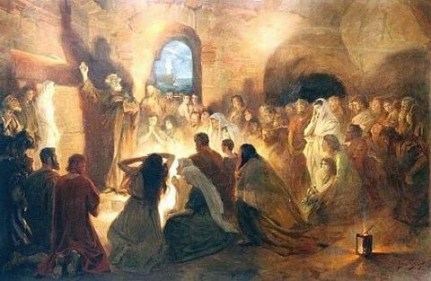
early church-peter preachingI just finished up teaching a class on a topic I’ve had my teeth in for a good while – God speaking. In fact, I wrote my master’s thesis on it as I described in this post here.

Naturally, a component of how God speaks today depends on how you consider New Testament prophecy. Just on the surface, when reading though the New Testament, especially Acts and 1 Corinthians, it does seem reasonable to conclude that we should expect that people would deliver prophecy just like they did in the Bible. In fact, I have spent much of my Christian life in churches where delivering prophecies was quite normal. Prophecies would range from exhortation to rebuking to foretelling what was in store for the church. It was also no uncommon for people to give private prophecies to individuals that typically included some type of foretelling, “look out for _____” or “in this season God is going to _______.” If you were to ask someone how did they know this was from God, a typical response would be “I just felt in my spirit.” In other words, there was some type of strong feeling that whatever words were being formed in one’s mind was God wanted to communicate.

However, the more I examine the New Testament, and specifically 1 Corinthians 14, the more I question this methodology of evaluating prophecies. I use this particular chapter as an example because I think it provides the clearest picture what transpired in the early church regarding the practice of prophecy to the body of Christ. In this regard, I think it can present the biggest challenge to a cessationist position that concludes that prophecy no longer exists, or at least the office of prophet no longer exists.

Without going too in depth and explaining in a cursory way, what I argue in my thesis and further developed in preparation for this class is that New Testament prophecies were proclaiming what the testimony of the apostles meant for the church. Keep in mind that during the New Testament accounts, the church had the Old Testament Scriptures, the testimony of the apostles and the word of the prophets. There was not a completed Bible. However, a holistic understanding of God’s self-revelation to humanity will see that the foundation of Old Testament provided the basis for what would be fulfilled in Christ, who completely and ultimately expresses the mind, will, character and plan of God. All New Testament activity portrayed in the epistles must rightly find their place in what God has done through the Son.

In light of this connection between Old and New Testaments, John Child, professor of New Testament studies at George Whitfield College in South Africa, states this in a fabulous essay entitled Towards an Evaluation of Charismatic Prophesies;

Since prophets claim their prophecies are from God and should be heeded, we should expect them to be tested under the new covenant We should expect the theological test to reflect theological development from old to new covenant; not just a fidelity to Yahwey but to Jesus Christ, not just to content in keeping with the Torah or Old Testament but in keeping with the progressive revelation or full revelation in the New Testament.
Continue reading

Yes, God does do as He pleases: confronting the idol of excitement

crowd_cheeringOver at The Gospel Coalition, Erik Raymond wrote how the cessationist position concerning gifts often receives the rebuttal, aptly titled for his piece, Don’t Put God in a Box. By cessationism, he means that the operation of certain gifts as normative practice have ceased. Since he uses the word normative, I can’t tell whether he means it can’t happen at all or rather there is no need for God to move this way in general today. I think this is an important clarification since the cessationist position often gets interpreted as not believing in miracles. Though there are some cessationist who take the position, I think it safe to say they are in a small minority. The rest of us would contend that God can work as he pleases  but does he really need to on a regular basis?

Nevertheless, this gets to the thrust what interested me about Raymond’s piece that I want to connect to a couple of other areas in which some say God must move. He rightly asserts that the God in a box argument is actually limited because it restricts movement of God to extraordinary events instead of seeing the whole of what God does in his divine Providence.

Now we see the issue clearly. It is not so much the gifts as the activity of God. We also see something of the reflex of 21st Century, particularly Western Evangelicalism. The thought is that the evidence of God working in the world is the miraculous. God shows up and we all know it. We know God is working when tragedy is averted, disease is healed, life is spared, and the occurrence of personal experiences that cannot be explained.

But, what if God’s work is far more than this? What if his activity in the world is not limited to our perception of the miraculous? What if God’s activity in the world is less like Superman—rushing in to ‘save the day’ and then rushing out before he is spotted—and more like Atlas—holding the weight of the world on his shoulders? What if God is not actor in the story of our life but that we are in his story? What if God is the writer, director, producer, main character, and set designer?

The doctrine of Providence helps us here. Providence is God’s infinite power that upholds and governs all things that come to pass. As the Heidelberg Catechism says,

“God’s providence is his almighty and ever present power, whereby as with his hand, he still upholds heaven and earth and all creatures and so governs them so that: leaf and blade, rain and drought, fruitful and barren years, food and drink, health and sickness, riches and poverty, indeed all things, come to us not by change but by his fatherly hand.”

The main things you need to know about this is that God is not disconnected from what is happening in the world today. God is upholding, governing, and ordering all things as with his very hand.

Continue reading

About that day I stood on a stage OR what is church commitment?

Multicultural groupI stood on a stage in June 2013. Well, it was more like a platform where they pulpit resides. I stood with several other people in front of the congregation. We were reciting vows. No, not saying “I do” in matrimony but definitely making a commitment to the local church.  We professed faith in Jesus Christ. We agreed to be involved in the life of the church. And, wait for it…we agreed to be submitted to it’s leadership and including, should the need arise, agreeing to church discipline.

“Wait, whoa, what? You actually agreed to THAT? That’s what cults do!” I might be the reaction of the reader. Of course, this came after a 12 week class on basic Christian doctrine, the definition and role of the church and Presbyterian specifics. We each met the pastor and one of the elders to give our testimony and share with them where we are spiritually. This does give one the opportunity to see if this is something they want to be committed to. (On a side note, I have made similar commitments before. But prior to joining the PCA, I came from a place with very loose commitments and little accountability and it showed.)

But given the reaction to the recent social media explosion over The Village Church, I can bet that this scenario immediately inspires thoughts of control, abuse, and squashing love for members. Now granted, there was some fumbling on their part especially considering the highly sensitive and painful nature of circumstances. They did apologize for the careless and insensitive way in which is was handled (not that it will ever be enough for public outrage calling for their pound of flesh). Nonetheless, I’m not writing about that specific incident because there’s been enough ink spilled already. Rather, I want to address the mass response that I saw that by and large rejected any type of commitments to pastoral intervention in the lives of its members. It made me question what exactly do we consider being part of the life of the local church.

I’m no fan of J.D. Hall of Pulpit and Pen nor the site, but I think he delivered what I believe to be a fitting and poignant commentary regarding the situation and specifically the reaction against making any kind of covenant with the local church as unwarranted, unbiblical and otherwise unnecessary. In this post here, he states, Continue reading

Acceptable worldliness in the Church

contemporary church service2Well, I’m going to say upfront that I might say some things that will rub some Christians the wrong way, especially those in the non-denominational world. I’m just putting it out there. In fact, it’s safe to say that this post might get a bit ranty. But I have observed a kind of worldliness that has been brought into much of contemporary evangelicalism that gets a pass.

No, it’s not having a hot band playing secular music or what some might associate with secular music with Jesus lyrics. Nor am I referring to sexual immorality with fornication and adultery going, although of course that can definitely be classified as worldliness worthy of some serious discipline.

I’m referring to the way we do church. And by that I mean, structuring church according to the philosophies of this world including borrowing leadership principles and techniques in the name of church governance. I’m talking about creating corporations with the senior pastor as CEO, elders as the board of directors, staff as the implementers of whatever vision was cast by “leadership” so the church achieves its outcomes for the consumers called the congregation.

I don’t know where it started. I don’t know when pastors/elders turned from being shepherds of Gods people with qualifications specified in 1 Tim 3:1-7 and Titus 1:7-9  into Jesus PR marketers, thought leaders, transformational strategists and vision casters. I don’t know when this informed the qualifications of leadership, with pastors being dismissed for ‘not being a good fit’ or ‘carrying out the strategies of the organization.’ I don’t know when it became acceptable to abandon the care of the visible church according to the vision Jesus already gave to come up with innovative techniques to run the company and franchising it out through satellite churches. I don’t know when pragmatism ran all over liturgy and kicked it out the door. I don’t know when the apostle’s teaching as specified in the NT, turned into storied, life principles and other cute methods to attract people, instead of boldly proclaiming the whole counsel of Scripture. Continue reading

Christian, what if your hurt had a higher purpose?

crowd_cheeringLet’s face it, we live in a therapeutic culture. Billions of dollars are spent each year on self-help tools, psychologists and other fixes to make hurt go away from our history, mistakes, present realities or future fears.

The church is not exempt, especially where triumphalism reigns supreme. Yes, you can grieve for pre-approved purposes but that has time limits. Whatever, your issue the predominant expectation is to “let it go.” Get over whatever you need to get over so you can be healthy because that would be victorious living.

Now, I get that we don’t want to live in dysfunction. We don’t want the pain of the past controlling us but rather to be controlled by our spiritual identity in Christ. Certainly we want to reconcile whatever brokenness exists in our lives. And seriously, no one wants to hurt emotionally or psychologically.  There is nothing pleasurable about pain and our desire is to remove it far from us as possible.But I wonder if that means that we should work to remove all hurt.

I am coming to the increased realization that suffering comes in many forms and is not so easily remedied by our trite prescriptions. Some things in life, people just don’t get over even with the assurance of a new heaven and new earth where all things will be made new. I confess, that I admire those who can just flip the switch and move on unfazed from whatever has pained them. But for many of us, we feel the prickly thorns of loss, discrepancies, failures, histories, etc. It’s so easy to ride on a pollyanna puffy cloud. Continue reading