
The ‘All Things’ You can do through Christ

man standing on rockPaul wrote to the Philippians

I rejoiced in the Lord greatly  that now at length you have revived your concern for me . You were indeed concerned for me, but you had no opportunity. Not that I am speaking of being in need, for I have learned in whatever situation I am to be content. I know how to be brought low, and I know how to abound. In any circumstance, I have learned the secret of facing plenty and hunger, and abundance and need. I can do all things through Christ who strengthens me. (Philippians 4:10-13)

I don’t know about you, but I have frequently heard that last line used in reference to some herculean task that needs to be done. Juggling too many balls in the air? Need to raise funds for that upcoming mission trip? Have to achieve a big project at work? Don’t worry, you can do all things through Christ who strengthens you.

As nice as these sentiments sound, they unfortunately miss the context of what Paul is addressing. Note first, that he is saying this in reference to contentment in circumstances.  Another observation concerning the context of this passage is that Paul refers to tangible needs being met, specifically financial needs.  Reading further in vv 14-18, his specific reference relates to ministry support though certain there can be application to individuals as well. But there’s something else here I think gets often missed. Christ gives strength through whatever circumstances we find ourselves in, whether it is flourishing or in need.

I don’t think anyone would complain about prospering and otherwise times of abundance. But when you are in need is a different story.  While Paul refers specifically to financial circumstances in ministry, I think there is an application for the loss and/or deficiency of various needs. It could be that you are unemployed or underemployed and unsure how the financial gap will be met. Or maybe you have been knocked out of the career loop or been demoted. Or maybe you lost your house or other material blessings or taken a hit in same way in ministry.  Such losses can be devastating, especially when it impacts your reputation and can make you feel underachieving or unaccomplished. Continue reading

Singing Honestly

worship singingIn a round about way, I suppose this could be a follow up on this post here where I asked if professional quality bands were necessary for good worship. Needless to say, the focus was on how we sing, not so much what we sing.

But that naturally leads to question about what we sing. How much do lyrics matter? Well, I’m kind of musing here though I suspect it might come across as nitpicking music. But I noticed some contrasts that really made me take note about what we sing.

As I was driving into work the other day, radio off doing my usual morning drive – thinking, praying, singing, I started to sing this old Hillsong tune that we played quite often back in my Charismatic worship team days

Lord I give you my heart, I give you my soul

I live for you alone

Every breath that I take, every morning I’m awake

Lord, have your way in me

I stopped singing. My first thought was ‘how dishonest’. While I do desire to honor the Lord in all I do, the reality is that I fall short often. I don’t always give my heart and soul nor do I live for God alone. I squeeze in me, more or less. Of course, my goal is to love the Lord with all my heart, mind and strength and love my neighbor as myself. But really, I don’t fully or consistently. Continue reading

The Unhelpfulness of ‘God Always Answers Prayers’

If there’s one thing that can be said of many Christians, is that we hate tension. Now some are more comfortable with it than others. But on the flip side, a disdain for tension can drive us into Cliche Land, where we resolve the tension with trite, but unfortunately not well thought out, sayings. One prime example of this is “God always answers prayers – yes, no or maybe”.

Now, what is typically meant by this is that you will either 1) get the answer you were expecting; 2) get the opposite answer with a denial or 3) Get a maybe…Stop! Would a maybe be the same thing as not knowing?

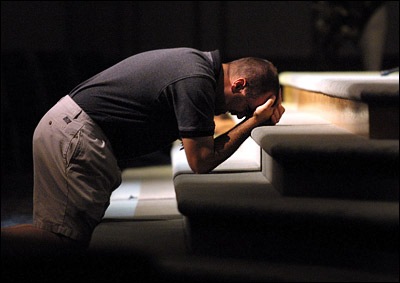
man praying at altarAnd that’s exactly why such a response to someone wrestling with unanswered prayers is not helpful. The reality is that until we know definitively, there is a period of time for which we have no idea what that answer will be. I actually think that “no” is not really an answer either, as I wrote about here. But as for the not knowing, I am often reminded, both in my own struggles with unanswered prayers and hearing of other accounts of the not knowing, that such a period can extend for a really long time.  It’s a long time of waiting…a long time of hoping…a long time of discouragement…a long time of not knowing.  Nothing will trivialize that struggle more than someone saying, God always answers prayer, with yes, no or maybe. Would you tell that to the childless woman who wants nothing more to be a mom and has suffered multiple miscarriages? Or to the parent with the wayward child who has drifted away for years? It’s kind of insulting when you think about it. Continue reading

Thawing the Theological Cold War

russian tank_cold warMy friend Karen sent me this article that really resonated with me, The Arrogance of Mutually Assured Destruction in the Church. It’s a pretty short post, so I’ll post it in its entirety;

During the Cold War between the United States of America and the former Soviet Union, the build up of nuclear arms became a standard practice. If one side built a weapon of mass destruction the other side countered with ever increasing numbers of more powerful and destructive weapons. The idea behind this proliferation was simple: if both sides knew that the other had weapons that could ensure total destruction, it functioned as a deterrent to go to war. This became known as the doctrine of Mutually Assured Destruction (MAD). As long as either side continued to equal or escalate armaments “peace” was maintained through “strength.”

Looking back on the Cold War, there was a kind of arrogance in this “peace.” Each side wanted to show that it was better and more powerful than the other, and if war would break out, victory would be assured in the destruction of the enemy. Ironically as long as victory over the other was the implicit goal, no peace was achieved!

How often in the church do we seem to practice an arrogant doctrine of MAD, seeking for personal or theological victory rather than peace and reconciliation? How often would we prefer a build up of arms rather than humility and grace? How often do we promote a Cold War between doctrinal camps, between rival theological perspectives, even between members of our own churches and families rather than make every effort to keep the victory of unity and peace already won in Jesus? (Eph. 4:3, Col. 2:15) The gospel calls us to unity and peace, but this can only be achieved when we put down our arms and in the humility demonstrated by God in Jesus Christ reach out to our “enemies.” This can only be done when we give up our own victory and arrogant plans and embrace the humility of Christ found in the gospel. Without this self-denial and sacrificial step, there is no chance of peace and unity. However, with the humility of Jesus we can put down our armaments, repent, forgive, and find peace.

Continue reading

Jesus Already Called, But We’re Not Listening

people not listeningI recently learned that the popularity of Jesus Calling, the devotional by Sarah Young, is bigger than I thought. Not only has the book sold over 9 million copies but there is a plethora of companion pieces, including a devotional Bible and phone app. Clearly, it has followed the path of the Purpose Driven Life and Prayer of Jabez that makes me wonder if Jesus told his disciples to go into all the world, therefore, and make merchandise. And let’s not be too quick to throw the authors and publishers under the bus because they wouldn’t be mass marketing Jesus products unless there was a demand based on sales.

So this post is not about Jesus Calling so much as it is about “us”. And by “us” I mean Christians who have soaked up this book and embraced it as if hugging Jesus himself. Because after all, the book is written in the first person as if Jesus himself is speaking. It occurs to me that there is something about this book that is appealing to people, especially women, and they have found comfort in it.

This book obviously resonates with people. To be sure, the popularity and evolution of companion products suggest that these devotionals feed something we need, or think we need and seek after.  The demand suggests that we need to have some kind of experience of Jesus in order to be satisfied with our Christian walk. And this leads me to ask why what God has already given us is not enough?

Don’t get me wrong. I’m not against experience. I think it is a necessary component of our humanity and especially more so in serving and worshiping an invisible God. The problem comes when we put experience in the driver’s seat for the sake of obtaining emotional comfort based on subjective means. Life is hard and pain is real for sure. We want assurance and relief during troubling times. We generally hate uncertainty. But that should drive us to rely on what God has sufficiently spoken instead of subjective words that come from others who claim to speak from God. Then you have to go through the gymnastics of figuring out if it is from God. As I wrote about in A Sure Word, why not just rely on what has already been written? Continue reading