Elevator Christianity

You’ve been in an elevator, right? You’re on one floor and you need to get to another floor. You push a button, hop in, press the floor that you want and ride up to that floor. It is not uncommon to treat Christianity like this. I think this happens anytime we create a two-tier type of Christianity: distinguishing between the “haves” and “have-nots.” The “haves” do something to press that button, which usually comes in the form of some type of prescription – do this to take you from here to there.

This can come in many forms. It’s going to the next level. Or it’s following Christ as opposed to believers who don’t really follow Christ (don’t get me started on that unwarranted distinction between Christians and disciples. You either are in union with Christ and indwelt with the Holy Spirit or you are not). Or it’s those that are Spirit-filled vs. those who aren’t Spirit-filled.  Or it’s those who really go out and do big things for God vs. those who don’t. Or it’s those who make disciples vs. those who don’t…and the list goes on.

I also think there is a self-centered focus on elevator Christianity. What is most important is to do whatever is required to get to that next level for yourself. If you’re not discipling enough, or not Spirit-filled enough, or not doing big enough things for God or aren’t surrendering enough, do X, press the button and then you have sufficiently reached your goal. And that is the point of elevator Christianity. Step in, do what is necessary, to reach your goal so you won’t be like those Christians who aren’t doing x, y or z. Continue reading


How to be Blessed by the Lord

man standing on rockNo doubt, I bet that title alone will pique the curiosity of the average Christian. That is what we want to know, right? How do I get my blessings so I can live my life like a victorious Christian. In fact, I think in general, we are so hungry to gain earn God’s favor, to feel like we’re doing the right thing and rise above our circumstances that might hinder what God has for us. And we can become so motivated by this pursuit that we reject anything or anyone that contradicts it.

This is an observation I’ve made that comes with this type of pursuit. So I know I’m not speaking to all Christians. But if your interest is how to be blessed to live your Christian life, then you have overlooked some vital issues related to the Christian faith. Now I bet just saying that has turned you off. But before you check out, please hear me out.

Christians are already blessed by the Lord because of their relationship to Christ. Also, Christians do not have to earn favor. Favor is nothing but the undeserved merit called grace which the Father has poured out through Christ. The reason I know that is because scripture tells me so. Now you may find Bible reading only profitable for what you can gain out of it so you can be successful. You may even read it through your own lens and gloss over the parts you find boring that don’t satisfy your quest to be blessed.

But in doing so you are overlooking exactly what the Bible is, God’s breathed out word that ultimately and sufficiently speaks of the Son and those who are united to Him through faith (2 Timothy 3:14-17). It is not a faith that compels us to live in pursuit of blessings but to see how God has already acted and spoken (2 Peter 1:16-21). That is why it is vital to see the Old Testament as what would ultimately be fulfilled in Christ based on the promises of God, the Law and the prophets (Matthew 5:17; Galatians 3:10-14). That is why it’s important to see the gospels and Acts as showing how that fulfillment takes places. It is important to see the epistles as the testimony to that ultimate fulfillment. And finally, look at how everything will be wrapped up in the end through the book of Revelation. Continue reading

Reaping, Sowing and the Power of a Paragraph

“Do not be deceived: God cannot be mocked. A man reaps what he sows.” (Galatians 6:7)

I have heard this verse use countless times in this manner: watch what you do because it will come back to you. And the next verse seems to validate this idea, “The one who sows to please his sinful nature, from that nature, from that nature will reap destruction; the one who sows to please his Spirit, from that Spirit will reap eternal life”.

A one on one correspondence, right? That is the way I’ve understood this passage for a long time. But I’m going to suggest that this interpretation misses what Paul is saying in the complete paragraph, which has to do with supporting the work of church leaders, Here’s the whole paragraph;

Anyone who receives instruction in the word must share all good things with his instructor. Do not be deceived: God cannot be mocked. A man reaps what he sows. The one who sows to please his sinful nature, from that nature will reap destruction; the one who sows to please the Spirit, from the Spirit will reap eternal life. Let us not become weary in doing good, for at the proper time we will reap a harvest if we do not give up. Therefore, as we have opportunity, let us do good to all people, especially to those who belong to the family of believers. (Galatians 6:6-10) Continue reading

Instead of Relevant…Go Retro

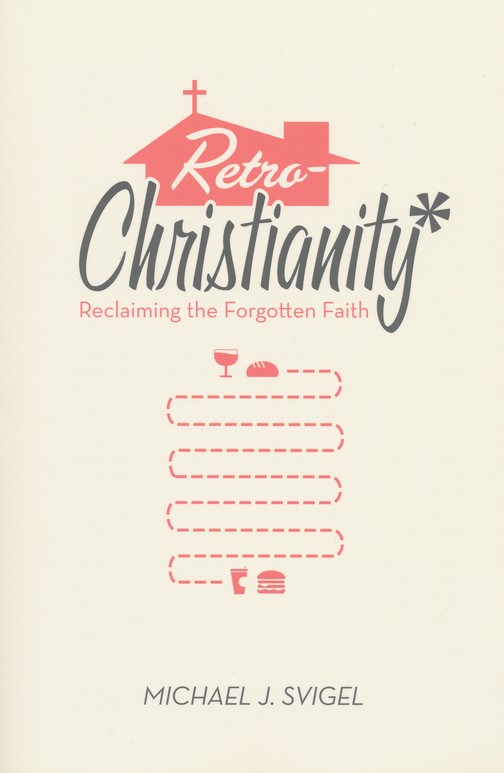
I’m off school for a couple of weeks, which has allowed me some breathing room and dig out from mire of Hebrew exegetical work and more. I still have a ton of school work but thought I’d catch up on some other reading as well. Since issues related to ecclesiology have been forefront on my mind lately, I picked up reading RetroChristianity, by Michael J Svigel from where I left off when the semester began. Now I confess I have a bit of a bias since Dr. Svigel is one of the profs in the Theological Studies dept at DTS, which is the dept of my ThM focus. But I also took him for Trinitarianism and Historical Theology I. Funny, Smart, a passion for church history (he loves the Apostolic Fathers), he has an even greater passion for Christians to think and behave Christianly and for the church to represent the faith well. This pours out of RetroChristianity and makes it a book worth reading.

In the past 500 years since the Protestant Reformation, things have gotten a bit crazy…and off course. Yet we live in the present and must contend with present realities. His solution is not abandon the present to capture the past NOR to forget the past and focus on the present (well actually we’re doing a pretty darn good job of the latter). Rather, he proposes reclaiming the past for the present.  In a nutshell;

RetroChristianity also acknowledges the egocentric nature of many evangelicals’ approaches to church and spirituality. We need to counter the preference-driven mentality rampant among so many churches, replacing it with a more biblical, historical, and theological framework through which we can make informed decisions regarding doctrine, practice and worship. This will help us wisely balance the vital elements of church, worship, ministry, and spirituality, avoiding excesses, extremes, distractions and distortions.(21) Continue reading

Walking the Tightrope of Sovereignty and Hope

I spent many years as a Charismatic and Word of Faith adherent. It was pretty common to embrace the notion of speaking life over circumstances (as if God was obligated to obey that) and believing that if one just stood on faith circumstances would work out in their favor. Add to that, being convinced that whatever subjective and often arbitrary “voice of God” led to the right to believe for certain outcomes. Well there are certainly concerns regarding that position, primarily that  these beliefs and practices undermine the sovereignty of God. The idea that we can have what we say in accordance with subjective leadings, smacks of human initiated and self-focused rights that presumes works on behalf of our bidding.

A survey of all 66 books of the bible should shout in our face that all request and desires are subject to the will of God.  Depending on what view of sovereignty you ascribe to, scripture is understood to deem God in ultimate control of his purposes being carried since he “works all things according to the council of His will.” (Ephesians 1:11).  To think that our prayers, desires and verbal proclamations can override what God intends is myopic at least and irreverent at worse.

I am of the conviction that everything happens by God’s sovereign choice, including election of His people (how we are called into God’s family). Yet on the other hand, I wonder if our deep awe and respect for God’s sovereignty can temper our expectations to irrelevancy that is concerned with very little beyond being accepted in the family of God.  Don’t get me wrong, we should be grateful for a deep and abiding grace that can turn an enemy of God into His beloved child and friend.  Regardless of your view of election, the fact is it had to begin with an extension of His grace made available to those who did not deserve it. It should produce a reverent fear that puts our humanity, with all of its wants and needs in perspective. Continue reading