
The Ultimate Fix: A Big Lesson in Little Things

broken cupsA couple of days ago, I woke up slightly agitated. I had contacted my mechanic the previous day to arrange an emergency drop off because all of sudden my car had been making a really loud noise in the front. Having a 17 year old car with over 200,000 miles on it, I’ve accepted that repairs here and there are a necessary evil. But so far, this evil has been far better than a monthly car note. Aside from the inconvenience of arranging rides, my bigger concern was the cost of repair. Being without steady employment, made me a bit anxious since I have to be really cautious about my money and had little room for the extra cost of a repair bill.

My agitation grew throughout the day as I waited to hear back from my mechanic. Normally, they are pretty good about assessing the problem and getting back to me with the estimate. I called them around 1:00 only to find that they hadn’t even looked at it yet. What? Immediately, my mind went to the arranging rides for the morning to get my son to school and me to school to take a final. Normally, they call before working on anything to let me know what needs to be done. The fact that they hadn’t even called by then made the possibility of not getting my car back a greater reality. But I still held out hope.

The drip from the toilet tanks and periodic rushing of water increased the agitation. I had put a work order in at least 3 times and stopped in the management office that morning to remind them of the job. It seemed like they were in cahoots with the mechanic! I tried to focus on the school work I needed to complete but could not stop being annoyed. No call from the mechanic. No one yet to fix my toilet. Just waiting and waiting and being annoyed.

Now you may be thinking how trivial and I agree. In the grand scheme of things, these are pretty inconsequential matters. And considering the bigger issues I’ve been dealing with in my life, I was getting annoyed with myself for being annoyed at such small things. And yet, as I strove to accomplish school work, I could not get rid of the restless waiting and growing annoyance. Stuff needed to get fixed and it was hanging in limbo. Continue reading

Help with the Final Seminary Push

If you’ve been following my blog for any length of time, you know that I am in the Masters of Theology (ThM) program at Dallas Theological Seminary. I began in fall 2008 and have and have now registered for my final semester. A lot has transpired in the past 5 1/2 years and I received many surprises along the way. It has not been an easy journey, especially as a single mother. But it has been a needed one on many levels. I am so grateful that in God’s providence and grace, I’ve had this opportunity for ministry training and theological learning.

Having had a successful career in Rhode Island, naturally I was a bit uneasy about the uprooting to attend seminary. But I knew that if this was something the Lord intended for me, he would make a way. My biggest concern was for employment, especially considering I would have to work part-time in order to handle everything and meet my financial obligations as head of the house. Thankfully, the Lord opened the door to a well-paying part-time job, which leverage my many years of experience working in human service funding and homeless services programming. The job was secure even before I moved, a clear signal that the road was paved for this next step.

This position sustained most of my seminary journey but sadly, ended in April 2013. Even worse, the following employment opportunity did not work out and I left mid-November. So as I head into the final semester, I am facing a number of things I wasn’t counting on, most notably a breach in employment that has lessened my ability to pay that final bill as well as some uncertainty in the next steps. Yet I am persistently reminded of God’s faithfulness through it all and that he surely has a plan for the ways in which he has uniquely gifted me for the sake of his kingdom. I am confident that he will provide the clarity and open door for the next steps.

But in the meantime, the payment deadline for the final spring semester is approaching on December 13th. Would you please consider helping out with it? I created a GoFundMe account to make donations easy.

Thank you for your consideration and for your interest in my writing. There is much more to come!

How Do Christians Change?

I like what M. Craig Barnes says about that. He writes,

pastor as minor poet“The restoration of Christ, often referred to as conversion, does not make us into different people but converts us back to what God designed us to be from the beginning – specifically, creatures who bear the mark of holiness. This is a progressive process through which we are changed ‘from one degree of glory to another’ (2 Cor. 3:18). But our movement through this sanctification occurs not through our own efforts at developing piety. It is only as the Holy Spirit binds us into the life of Christ that we are able to take on his holiness. Thus, our spirituality is always vicarious, since it is through this union in Christ that are made holy. He is the image of God that we bear in our lives.

The significance of this for pastoral encounters is found in the unique way we invite people to make changes in their lives. We do not peddle images of the super-Christian and tell our parishioners to try harder to attain the goal. That’s just another false image. And it will leave us only with more judgment by tossing out the not-good-enough Christian into our heap of failures. The only way out of the judgement trap is for pastors to keep pointing to the true image of the God in whom ‘we live and move and have our being’ (Acts 17:28). This is the God revealed in Jesus Christ, ‘and we have seen his glory, the glory as of a father’s only son, full of grace and truth’ (John 1:14). So with poetic irony, pastors help people to change not by talking about them, but by talking about the God revealed in Christ.” (93)

This is so much in line with what I wrote a while back Why I Do Not Teach Christian Living Principles. Somehow, this idea exists that Christians mature by giving them a list of principles to measure up to and then pointing out how they are not measuring up. This only creates condemnation or self-righteousness. Rather, we are changed into the image of Christ through identification as the Holy Spirit does his work and we respond to that work, accordingly.

Disappointed? It’s your fault of course

sad_manI’ve been mulling over this article You Can’t Turn Lemons into Lemonade, especially as I wrestle with some deep, abiding and lengthy disappointment. I appreciated the honesty in which the author acknowledges that we do experience disappointment in this life. Try as we might, we just can’t make it right so its important to think about our disappointments theologically and put them in perspective.  I noticed some of the reactions to it that made it seem like as long as we know of our future hope, we should not be disappointed.

I’ve heard this before…

I often get the impression in our Christian circles that disappointment is taboo. It’s not that disappointment is not a reality but when we do get disappointed, its because we need to adjust our attitudes.  I have often heard this expressed this way – the problem is our expectations. If we could just temper our expectations than we won’t be disappointment anymore. The underlying sentiment is that disappointment is a product of our own choosing, that if we make the necessary changes than we should not be disappointed. But more telling in this sentiment is the understated reality that somehow disappointment is our fault.

But what this misses is the fact that we live in imperfection. Our lives are not perfect and neither is the world.  I’m struck by Paul’s words in Romans 8

For I consider that the sufferings of this present time are not worth comparing with the glory that is to be revealed in us. For the creation waits with eager longing for the revealing of the sons of God. For the creation was subjected to futility, not willingly, but because of him who subjected it, in hope that creation itself will be set free from its bondage of corruption and obtain the freedom of the glory of the children of God. For we know that the whole creation has been groaning together in the pains of childbirth until now. And not only creation, but we ourselves, who have the firstfruits of the Spirit groan inwardly as we wait eagerly for adoption as sons, the redemption of our bodies. For in this hope we are now saved. Now hope that is seen is not hope. For who hopes for what he sees? But if we hope for what we do not see, we wait for it with patience. (Romans 8:18-25) Continue reading

Food is Fellowship

friends-eating-chocolateIn the Purpose Driven Life, Rick Warren provided a section on fellowship and noted that food is not fellowship. I recall when I first read that years ago, I thought it made sense. Since that time, I’ve come to appreciate the value of gathering around our most basic need and see it as symbolic of something so much more.
So when I came across this quote in a book I’m reading for one my classes, it really resonated with my thoughts on feasting. Moreover, how incredibly fitting to come across this on Thanksgiving eve.

It is amazing how much of the biblical story involves eating. It starts with the creation of a hungry man and woman and ends with a messianic banquet. In the Old Testament, covenants are sealed with meals. Good and bad choices are made over food, whether it be a bowl of porridge or a great banquet. And it is by eating the Passover Seder that the Hebrews remember God’s deliverance. In the New Testament, Jesus performs his first miracle at a wedding reception, feeds thousands of people, establishes his sacrament of grace at the Last Supper, and is revealed to travelers with the breaking of bread. Even the first church squabble is over the Gentile widows being left out of the distribution of bread. Clearly, the biblical depiction of humanity is that we are created hungry, but eating is so much more than mere fuel for our material bodies…

God gave us food, the most basic material need of life. That means it’s a blessing. To call it a blessing is to claim that it is a means for knowing God. This is why we teach our children to bow their heads and say a prayer of thanks before the family eats. In those little prayers before the meal, we are reminding ourselves that even eating is a means of having communion with God. We do that because our real hunger is for the giver of the blessed food, and we can know this God even in the most ordinary material act of sitting down to a dish of overcooked lasagna.[1]

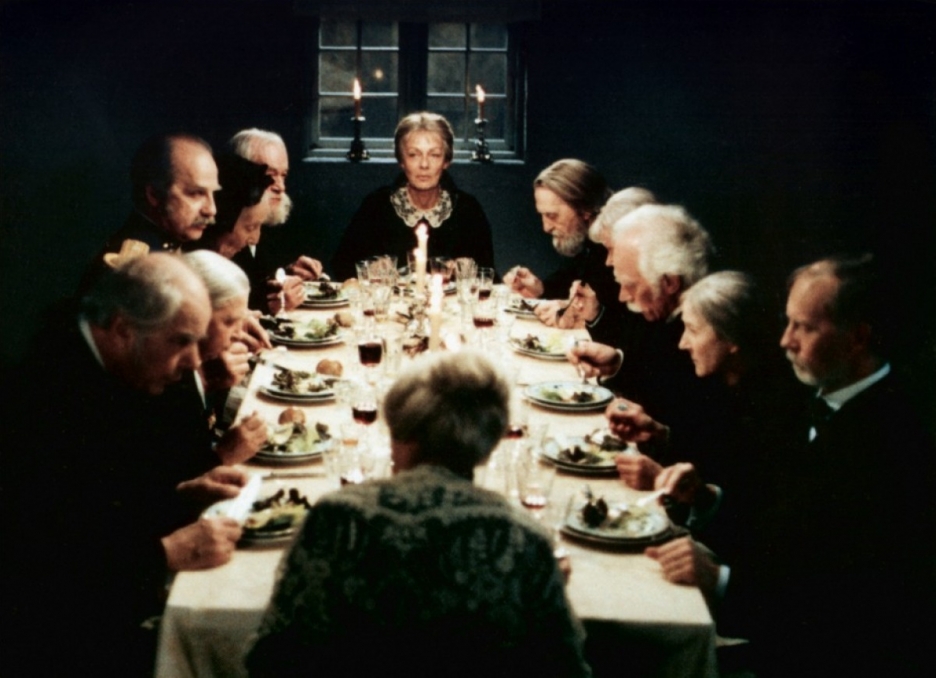
babettes feast_table gatheringYes, isn’t it amazing how communal food can be? Not only that, but there’s something about feasting on our most basic of needs that points to the supplier of those needs. It’s why I believe beautiful tasting food evokes worship (or should). The movie Babette’s Feast provides a poignant story of the power of food to bring people together and the sacrifice of one who caused it to happen. A great reminder of the communion that Christ’s church receives because of his sacrifice.

This also should raise our sensitivity to those who struggle with having food or lack opportunities to gather around the table with others. If you are fortunate enough to have that on Thanksgiving, enjoy your feast and let it serve as a reminder of our greatest hunger and need for Christ.

“I am the bread of life; whoever comes to me shall not hunger and whoever believes in me shall never thirst.” (John 6:35)

[1] M. Craig Barnes, Pastor as Minor Poet: Texts and Subtexts in the Ministerial Life (Grand Rapids: Eerdmans Publishing, 2009), 32-33